Institut de recherche mathématique avancée
L'institut
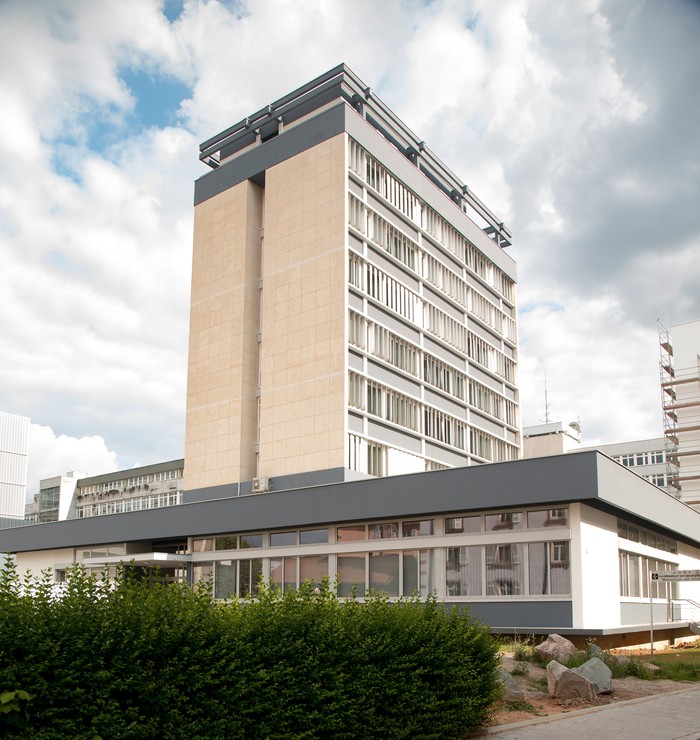
À la une
Agenda
-
Lundi 2 novembre 2026 - 14h00 Séminaire Géométrie et applications
-
Skander Charfi :
À venir
- Lieu : Salle de séminaires IRMA
-
Résumé : TBA
-
Mardi 3 novembre 2026 - 10h45 Séminaire Calcul stochastique
-
Alice Contat :
Brûler la grille et équation de Blasius
- Lieu : Salle de séminaires IRMA
-
Résumé : On se place sur le tore (discret) de côté n et de dimension d. Imaginons qu’un pyromane allume des départs de feu alors que pendant ce temps, le feu se propage le long des arêtes. Au bout de combien de temps le tore sera-t-il entièrement brûlé ? De manière peut-être surprenante, la réponse à cette question est liée à l’étude de l’équation de Blasius y^(d+1) = y \cdot y^(d). Basé sur des travaux en commun avec Guillaume Blanc.
-
Mardi 3 novembre 2026 - 14h00 Séminaire Equations aux dérivées partielles
-
Damiano Lombardi :
Low rank approximation for state and parameter estimation
- Lieu : Salle de conférences IRMA
-
Résumé : State and parameter estimation often involves a prohibitive computational cost, especially when the mathematical model describing the system is a set of parametric partial differential equations. We will investigate a sequential Bayesian estimation method and see how low-rank approximation, in conjunction with a projection-based interpolation, can significantly speed-up the problem and alleviate the memory burden. Several numerical tests will be presented, on fluid-structure interaction problems. Many systems are characterized by conservations (e.g. mass, energy). The ability to conserve these quantities at discrete level can be precious also in data assimilation problems. In the last part of the talk, a contribution will be presented, on the use of a mixed formulation for the structure preserving conformal variational discretisation of Hamiltonian PDEs with gradient flow dissipation.
-
Mardi 3 novembre 2026 - 14h00 Séminaire ART
-
Chris Bowman :
À venir
- Lieu : Salle de séminaires IRMA
-
Résumé : TBA
-
Jeudi 5 novembre 2026 - 09h00 Séminaire Sem in
-
Salim Alloun :
La théorie mathématique des dessins d'enfants.
- Lieu : Salle de conférences IRMA
-
Résumé : Dans cet exposé je présenterai la théorie des dessins d'enfants de Grothendieck sous différents angles : celui de la topologie des surfaces, puis celui de la théorie des nombres. Tout ça à travers des exemples explicites et quelques anecdotes historiques. J'essaierai de faire en sorte qu'à la fin de l'exposé chaque personne puisse s'en aller avec sa bouture :-)
-
Jeudi 5 novembre 2026 - 14h00 Séminaire Arithmétique et géométrie algébrique
-
Arnaud Eteve :
Représentations des groupes réductifs sur les corps finis sans corps fini
- Lieu : Salle de séminaires IRMA
-
Résumé : Soit $G$ un groupe réductif sur un corps fini $\mathbb{F}_q$, une des premières interactions en la théorie des représentations et les techniques de cohomologie étale vient de la théorie de Deligne-Lusztig. C'est une théorie de nature géométrique qui consiste à réaliser les représentations du groupe fini $G(\mathbb{F}_q)$ dans la cohomologie étale des variétés éponymes. Ce domaine de recherche est en pleine transformation grâce à l'introduction de nouvelles méthodes appelées traces catégoriques provenant de la théorie des catégories supérieures. Ces dernières permettent de recontextualiser les résultats essentiels de la théorie et établissent un pont entre avec la théorie géométrique des représentations, cette dernière ayant pour intérêt des catégories (monoidales) de faisceaux sur des objets géométriques associés au groupe algébrique $G$. Le but de cet exposé sera d'expliquer la construction principale qui consiste à réaliser la catégorie des représentations de $G(\mathbb{F}_q)$ comme une trace catégorique d'une catégorie explicite, puis dans un deuxième temps d'illustrer cette construction avec une nouvelle application ou l'on construit une déformation (d'une partie) de cette catégorie où $q$ devient un paramètre formel.